1. The Familiar Failure
Many organisations embark on ambitious initiatives to improve how they work by introducing new enterprise systems, systems designed to increase efficiency, break down information silos, and deliver clearer reporting and insights for leadership.
Yet, despite good intentions and significant investment, the outcome is often the same: slow adoption, weak engagement, poor data quality, unreliable reporting, and a return on investment that never fully materialises. Quietly, and often unofficially, staff revert to old tools the moment enforcement fades.
This pattern is common across large organisations. And while it is often blamed on resistance to change or poor training, those explanations rarely go far enough. The deeper issue is usually not whether the system works, but whether it works in the reality of day-to-day operations.
2. The False Assumption
Many organisations still believe adoption will follow if a new system matches documented processes, is supported by training, and is backed by a company-wide mandate.
It rarely works that way.
Training builds understanding and familiarity. It does not make the system fit the reality of their work. Mandates may drive short-term compliance, but they do not create genuine engagement. Usage should be enabled, not enforced.
That is why behaviour often reverts the moment scrutiny eases. People do what is necessary to appear compliant, while the real work continues elsewhere.
This is where many enterprise rollouts begin to fail. The system may be technically live, but the behaviour it depends on has not truly taken hold.
3. Where UX and Real Behaviour Diverge
Enterprise systems are often designed around formal process flows: ordered sequences intended to standardise work, clarify responsibility, and improve control.
That logic is useful, but it is not the same as operational reality.
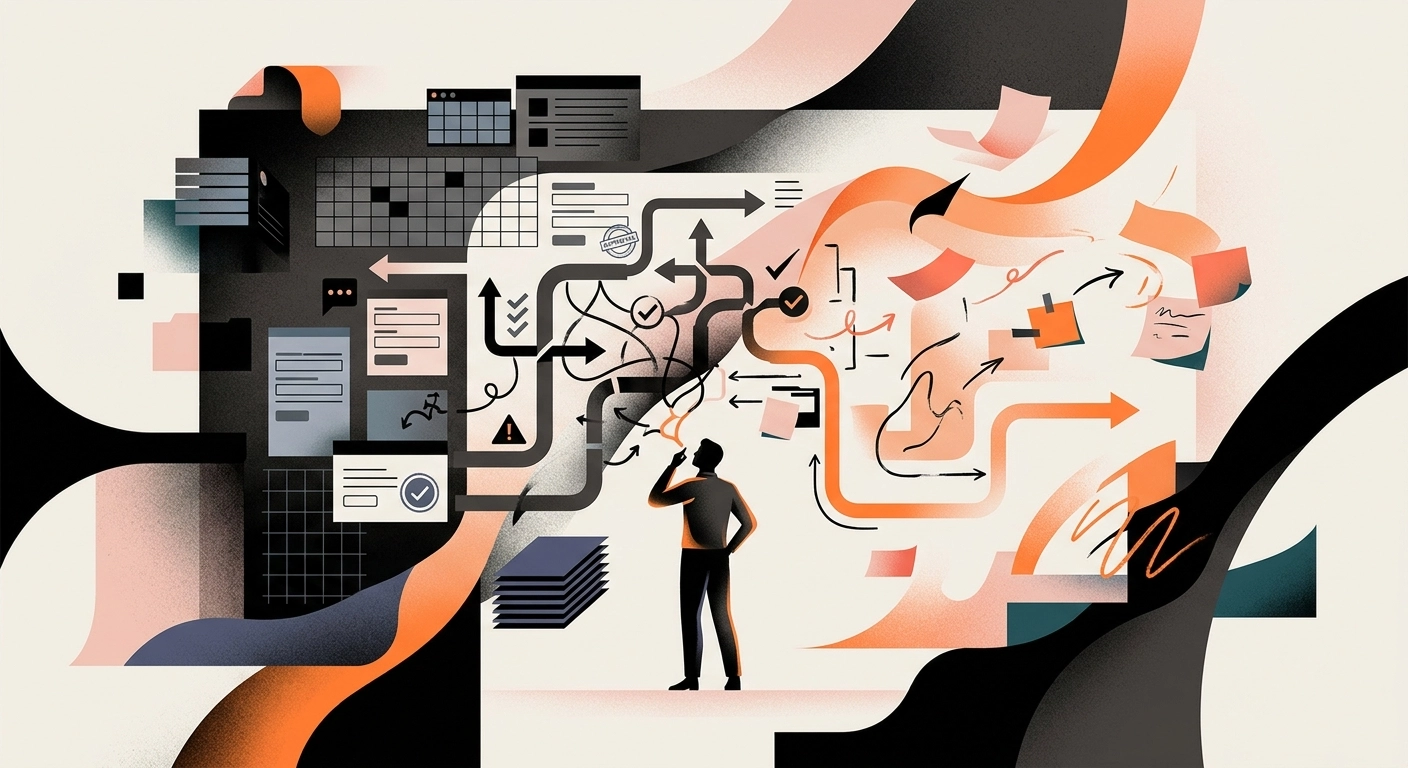
In practice, work is rarely linear, uninterrupted, or uniform. Steps may be skipped, repeated, reordered, or handled differently depending on context. Timing shifts. Exceptions emerge. Judgement is applied. Coordination happens across people, pressures, and constraints that no process diagram truly fully captures.
This is the point at which UX becomes strategically important. The interface is not simply presenting a process. It is shaping how that process must be carried out in practice. If that structure is too rigid for the reality it is meant to support, misalignment is introduced at the point of use.
4. The Cost of Misalignment
When a system is built around rigid, idealised flows, friction appears quickly. The system starts dictating how work should happen instead of supporting how work actually happens.In these moments, friction is not a failure of discipline or intent, it is a failure of design to accommodate human behaviour within operational constraints.
When users hit that friction, they adapt. They develop workarounds, skip steps, capture information elsewhere, or delay using the system until it becomes unavoidable. These are not acts of resistance; they are rational responses to friction.
Over time, those adaptations quietly become the real operating model. Data becomes inconsistent. Trust in reporting erodes. The system adds effort rather than reducing it. What initially appears to be a tool for operational improvement instead becomes an invisible cost centre, difficult to measure and even harder to manage.
In high-stakes environments, the consequences of that misalignment can surface fast. A widely cited example is Cedars-Sinai Medical Center, which suspended its computerized physician order entry system in January 2003 after more than 400 physicians pushed back and voted almost unanimously to halt it. The objection was not simply about reluctance to change. Contemporary accounts described the system as unsafe and overly burdensome, while later analysis framed the failure as a case of implementation pressure colliding with the realities of clinical workflow. The core problem was not digitisation itself, but the imposition of a mandatory workflow that did not fit the way work actually needed to be done.
What appears at an executive level as poor adoption or low ROI is, in reality, the downstream effect of behavioural misalignment at the point of use.
5. Why Requirements Gathering Falls Short
For systems to reflect reality, reality must be studied directly. That usually means spending more time with frontline teams, observing how work actually happens, and surfacing the tacit knowledge that rarely appears in process maps or stakeholder interviews.
This is exactly the step many delivery efforts rush past.
Requirements gathering is often built around documented workflows, senior stakeholder input, and high-level process logic. That may be efficient, but it leaves out the people closest to the work. The result is predictable: the organisation designs around the official version of operations while missing the practical one.
The consequences can be significant. The NHS National Programme for IT is a clear example. It aimed to give every patient an electronic care record by 2010, yet by 2011 the National Audit Office had concluded the target would not be met, questioned the poor value for money of the £2.7 billion already spent on care-record systems, and found that in one major area only 4 of 97 systems had been delivered to acute trusts after seven years. Later reviews pointed to a familiar pattern: too much centralised control, too little local ownership, limited clinical engagement, and an attempt to deliver too much, too quickly.
That missing layer matters. Frontline teams know where processes break down, where exceptions occur, where handoffs fail, and where the system will create friction long before leadership sees it in a dashboard. Ignore that knowledge, and you are designing fiction.
The cost of uncovering this insight upfront is real. So is the cost of not doing it. One shows up early in the project. The other appears later as poor adoption, weak data integrity, low trust in reporting, and systems that create more friction than value.
6. The Role of UX as a Behaviour-Shaping Tool
This is where UX becomes strategic.
If training and mandates try to change behaviour from the outside, UX shapes behaviour from the inside. It influences how work unfolds within the system itself.
Every interface encourages some behaviours and discourages others. Workflow structure, defaults, validation, sequencing, feedback, and error handling all shape what feels easy, natural, or frustrating. Over time, users gravitate toward the path that requires the least effort and interruption. That is not a design detail. It is behavioural reality.
A simple example comes from HMRC. Rather than treating support as something separate from the user journey, it tested placing webchat at the points where confusion was most likely to occur. On one target page, that small change increased customer satisfaction, while support tickets fell by 43% and phone calls by 12%. The lesson is straightforward: when help appears inside the flow of work, users are more likely to keep moving and less likely to drop out or escalate.
This is why UX in enterprise systems should never be treated as surface polish. It determines whether the right behaviour is frictionless or whether the system accidentally rewards shortcuts, inconsistency, and avoidance.
When UX is handled too late, systems often reinforce the wrong habits. They over-prioritise theoretical compliance and under-prioritise task completion. They demand too many steps, too much context switching, and too much cognitive effort for routine work. Users respond accordingly.
When UX is treated as a strategic discipline, the opposite happens. The system guides behaviour without coercion. It reduces errors, improves consistency, and aligns day-to-day actions with business goals.
Most importantly, strong enterprise UX does not assume perfect conditions. It accounts for variability, exceptions, and judgement. It supports outcomes without forcing people through unrealistic models of work.
Seen properly, UX is not about making systems look better or even feel smoother. It is about making the right behaviour the easiest behaviour. That is how adoption improves. That is how data quality improves. That is how enforcement becomes less necessary over time.
7. How to Build for Reality: Turn Adoption into Outcomes
Enterprise systems are supposed to improve how work gets done. When they fail to do that, the problem is rarely a lack of features or effort. More often, the system was built around process theory instead of operational reality.
Fixing that does not require more pressure, more dashboards, or more training. It requires treating UX as a strategic lever for shaping behaviour where work actually happens. In practice, that means four shifts.
Involve frontline staff earlier
Not as a final validation step, but as a source of operational truth from the beginning. The people closest to the work usually know where friction will appear long before the project team does.
Measure UX through operational outcomes
Satisfaction scores only tell part of the story. Adoption, error rates, cycle times, rework, and data quality reveal whether the system is genuinely improving work.
Treat UX as a strategic investment
The effort required to understand real behaviour upfront is often repaid downstream through lower enforcement, stronger reporting, and systems that hold their value over time.
Design for variability, not idealised flows
Real work includes exceptions, interruptions, and judgement. Systems that can absorb that variability are far more likely to earn sustained use.
When UX is approached this way, enterprise systems stop being tools that merely digitise processes. They become instruments for operational improvement. And that is the real test.
If a system has to rely on constant enforcement to sustain usage, it is not succeeding. Good UX does not force adoption. It earns it.